DFDewey FairchildProblem Solver
MENU
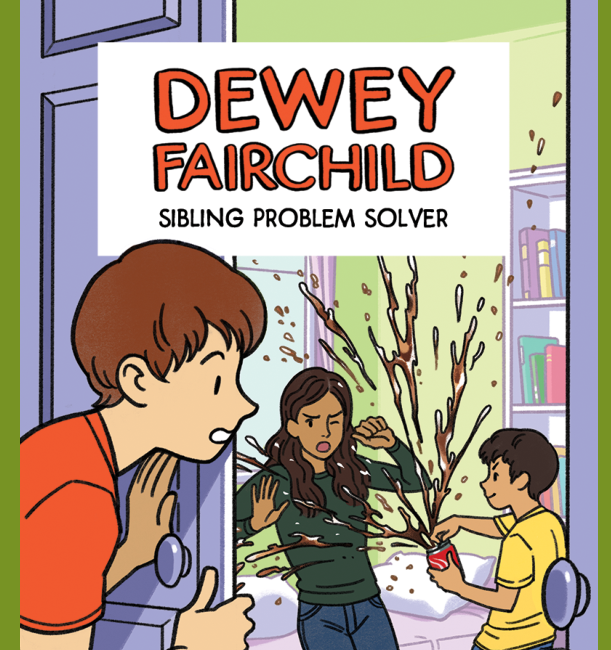
Cover of Dewey Fairchild, Sibling Problem Solver by Lorri Horn

CASE FILE #03 • SIBLING DIVISION • FULL-BOOK ARCHIVE

Dewey Fairchild, Sibling Problem Solver

August 6, 2019Paper-over-board & eBook256 pagesISBN 978-1-948705-41-7Middle Grade FictionBook 3

Book three begins with Dewey's problem-solving office reopening after winter break and ends with the office's biggest secrecy problem yet: his own family has found the place. In between, the business expands from parent and teacher problems into a full sibling division.

The sibling cases are not one-note arguments about sharing. Dewey has to untangle attention, privacy, retaliation, family rules, technology, social media, adoption, older-and-younger-sibling dynamics, and the difference between the problem somebody reports and the need underneath it.

Clara recommends checking more than one shelf. Books have a habit of wandering between formats and sellers.


Sibling problem?

The sibling division is open—and now fully mapped.

WHAT THE FULL INGESTION ADDS

The sibling division has an actual map now.

The complete source pass makes the structure of Book 3 much clearer: several apparently unrelated problems keep leading Dewey toward the same question—what is the person underneath the annoying behavior actually trying to get?

ARCHIE + ANGELICA THOMAS

Rules, gaming, and social media

Archie first comes to Dewey over a total weekday electronics ban. Dewey researches the case from more than one direction instead of simply collecting evidence for Archie's side. The resulting family compromise creates a new problem for Archie's older sister Angelica when their mother becomes much more active online.

CLAIRE + ADAM BAUTISTA-KNICKERBOCKER

Teasing, retaliation, and a plan that works too well

Claire wants her younger brother to leave her alone. Dewey's investigation turns into a bicycle scheme designed to give the siblings a common problem. It changes Adam's behavior—but the fake crisis nearly becomes a real police matter.

EFREN + LOUISE DISK

The fight is not really about Lego

Dewey observes the Disk family from their laundry room and eventually sees what the initial complaints miss: Louise keeps invading Efren's space because she wants time with him. The solution shifts from stopping individual fights to preventing the cycle that keeps producing them.

DEWEY + STEPHANIE + POOH BEAR

The solver becomes part of the experiment

Dewey's own sisters keep entering the case file. Stephanie forces him to notice boundaries from an older sibling's point of view, while a short stretch of focused play with Pooh helps him understand what a younger sibling may actually be asking for.

DEWEY'S METHOD

Observe. Question. Reframe. Test. Revise.

Across the book, Dewey's most useful moves are less about instant clever answers and more about gathering better evidence.

OBSERVATIONCOUNTER-EVIDENCEUNDERLYING NEEDSPROTOTYPING

1. Watch what people actually do.

Dewey repeatedly goes into the environment instead of relying only on a client's summary. The Disk case changes when he sees the sibling conflict directly.

2. Search against the first answer.

When Archie's mother makes claims about gaming, Dewey initially finds material that seems to support her. Clara pushes him to look for counter-positions too, and the case becomes more complicated—and more useful.

3. Separate the object from the problem.

Lego, dolls, bedrooms, bikes, phones, games, and social media can be the visible fight without being the underlying issue. Dewey keeps trying to locate the need beneath the object.

4. Test ideas in the world.

Drones, earpieces, staged bicycle trouble, observation posts, and a Parrot Jumping Sumo all become tools for gathering information or trying a solution. Some tests succeed. Some create entirely new problems.

5. Use his own life as data.

Dewey is not outside the subject. His experiences with Stephanie and Pooh Bear become part of how he learns to understand other sibling relationships.
THE WORLD AROUND THE CASES

Book 3 keeps widening the Dewey universe.

The source archive adds concrete places, objects, foods, technologies, routines, and relationships that make the series more than a list of problems.

Secret attic officeAir-duct client entranceGarage GatorClara's cookiesWolfieWoodbine Middle SchoolBig Ship parkSouthern California June GloomDronesVideo gamesSocial mediaParrot Jumping SumoSriracha popcornGerman chocolate-cake cookiesAdoption & family history

BOOK DATA

Publication file.

EDITION

Book 3

Published in 2019 by Amberjack Publishing. The source identifies the paper-over-board ISBN as 978-1-948705-41-7 and the eBook ISBN as 978-1-948705-42-4.

AUTHOR

Lorri Horn

The book's author biography identifies Horn as an educator, English-degree holder, credentialed teacher, and Nationally Board Certified educator who had taught public school for more than fourteen years.

RELATED FILES

Keep following the sibling evidence.

Book 3 now connects to a dedicated case map plus the broader family and middle-grade reader guides.

OPEN ANOTHER DRAWER

Same office. Different drawer.

Cases, chronology, people, connections, places, objects, snacks, sayings, and Clara's search cabinet are different ways into the same Book 3 file.