ATTENTION
When “leave my stuff alone” really means something else
In the Disk family, Louise repeatedly enters Efren's space and handles his things. Dewey eventually realizes she is not mainly after the Lego: she wants time with her brother.
READER GUIDE • SIBLING DIVISION
Brothers who will not leave you alone. Sisters who enter your room at the worst possible time. Younger siblings who want attention. Older siblings who want space. Family rules that solve one person's problem and create another person's. Dewey Fairchild, Sibling Problem Solver turns all of that into a case file.
WHY THIS BOOK FITS THE SEARCH
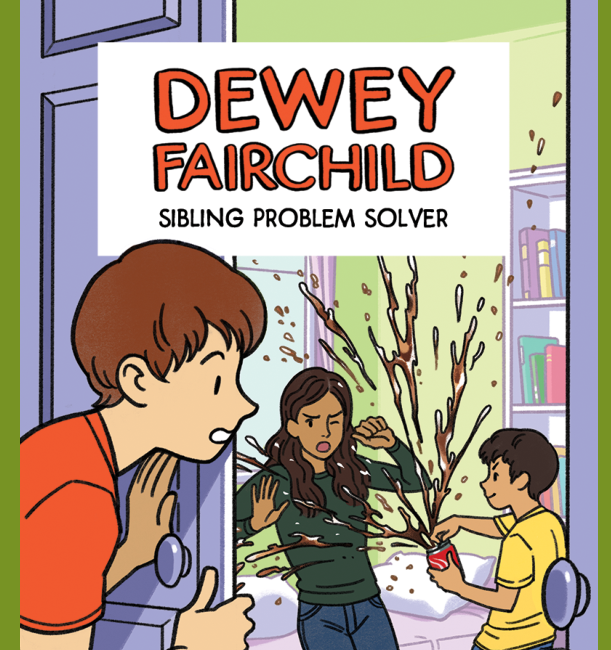
The third Dewey Fairchild novel formally expands Dewey's business into sibling cases. The book follows several different kinds of conflict instead of reducing brothers and sisters to one generic rivalry.
ATTENTION
In the Disk family, Louise repeatedly enters Efren's space and handles his things. Dewey eventually realizes she is not mainly after the Lego: she wants time with her brother.
PRIVACY & BOUNDARIES
The book repeatedly treats bedrooms and personal space as meaningful territory. Dewey even learns from his older sister Stephanie that he can be the intrusive younger sibling from somebody else's point of view.
TEASING & RETALIATION
Claire wants Adam to stop teasing and bothering her. Dewey's attempt to change the relationship by giving them a common bicycle problem works—but nearly creates a much more serious complication.
FAMILY RULES & TECHNOLOGY
Archie's complaint about weekday electronics leads to a family compromise. That compromise then creates a different problem for his older sister Angelica when their mother's online participation increases.
WHAT DEWEY ACTUALLY DOES
Dewey is funny partly because his solutions can become elaborate, but the recurring process underneath them is serious: gather evidence, challenge the first explanation, identify the need beneath the behavior, and test a possible solution.
Observe: Dewey hides in homes, watches family routines, and pays attention to what siblings do rather than relying only on what clients say they do.
Question: In Archie's technology case, Dewey looks for evidence that challenges his preferred answer instead of only building a case against the parents.
Reframe: The object being fought over may not be the true problem. The Lego matters because it reveals a conflict over attention and space.
Test: Dewey uses everything from earpieces and drones to staged scenarios and short periods of focused sibling time.
Revise: A solution can generate another problem. The book treats that as more data, not as proof that problem solving is finished.
FOR READERS WHO LIKE
The book's world is full of recognizable kid-life details: rooms, bikes, video games, social media, school, parks, family car rides, pets, food, and privacy. Dewey approaches those ordinary things like evidence.
CASE FILE #03 • LORRI HORN
Published in 2019, Book 3 follows Dewey as sibling problems become a new division of his secret problem-solving business. The book's publisher materials identify it as middle grade fiction and emphasize siblings, problem solving, teamwork, creativity, family, technology, moderation, and comedy.
OTHER FAMILY TROUBLE
See the broader family guide, the funny-middle-grade guide, or the full series index.