READER GUIDE • FAMILY DIVISION
Middle grade books about family, without pretending families are simple.
Dewey's cases begin with one of the most dependable sources of kid problems: the people at home. Parents embarrass you. Siblings enter your room. Rules collide with independence. Younger kids want attention. Older kids want space. Even a loving family can be an excellent source of trouble.
Ages 9–12ParentsSiblingsAdoptionFamily rulesPrivacyAttentionHumorProblem solving
THE SERIES ARC
Family is not one case. It is the system around every case.
Dewey Fairchild, Parent Problem Solver begins with parent-child friction as the central mystery. By Sibling Problem Solver, Dewey discovers that brothers and sisters require an entire new division—and that his own family belongs inside the investigation too.
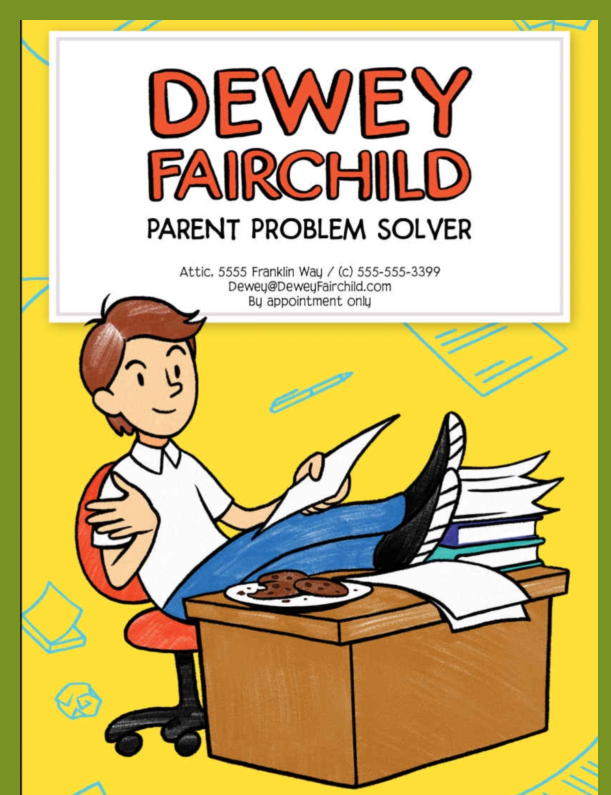
BOOK 1 • PARENTS
Parent Problem Solver
Dewey turns complaints about parents into a secret problem-solving business. The cases involve overprotection, embarrassing habits, rules, communication, and eventually a family problem Dewey cannot treat as somebody else's.
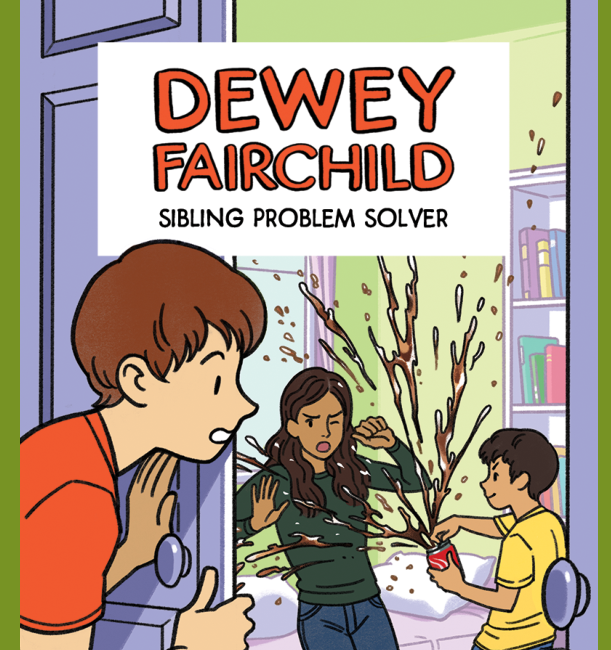
BOOK 3 • SIBLINGS
Sibling Problem Solver
Brothers and sisters bring conflicts over teasing, privacy, rooms, attention, technology, and family rules. Dewey's own sisters become part of how he learns what sibling problems actually need.
FAMILY THEMES IN BOOK 3
The complete sibling file makes several family patterns visible.
Because Dewey investigates multiple households, the book can compare different family systems instead of treating one set of parents or siblings as universal.
ATTENTION VS. SPACE
The same relationship can contain opposite needs
Louise Disk wants more time with her older brother Efren; Efren wants more control over his room and belongings. Dewey's solution only begins to work after he treats both needs as real.
RULES AFFECT EVERYBODY
A solution for one child can create a problem for another
Archie's electronics case produces a broader family technology compromise. His older sister Angelica then experiences the consequences when their mother becomes more involved in online family life.
OLDER & YOUNGER SIBLINGS
Perspective changes with position
Dewey is annoyed when Pooh wants his attention, but he also discovers from Stephanie that he can be the younger sibling intruding on somebody else's time. The book lets him occupy both roles.
FAMILY STRUCTURE
Adoption is part of Dewey's family history
Book 3 explicitly revisits the Fairchild family story: Dewey is adopted, while Stephanie and Pooh Bear are his parents' biological children. The family's own language emphasizes that all three are equally real members of the family.
WHY PROBLEM SOLVING WORKS AS A FAMILY LENS
Dewey has to stop asking who is right long enough to ask what is happening.
The family cases become more interesting when Dewey separates the reported complaint from the pattern underneath it.
LISTENOBSERVECOMPAREREFRAMETRY AGAIN
Parents and children can describe the same rule differently. Siblings can describe the same fight differently. Dewey's fieldwork—watching routines, listening to competing explanations, and testing ideas—turns family disagreement into something that can be investigated rather than simply won.
FAMILY DIRECTORY
The Fairchild family has its own case history.
Follow the family members who move through Dewey's home life and, eventually, his secret office.
KEEP LOOKING
More routes through the family file.
Open the dedicated sibling guide, the Book 3 case map, or the full middle-grade series index.